Today, Wednesday, April 22, 2026, the Solemnity of Saint Joseph and the Commemoration of Popes Saints Soter and Caius.
This great solemnity with Pope Pius IX in 1847 as the Patronage of Saint Joseph before being given its current name, the Solemnity of Saint Joseph, by Pope Saint Pius X in 1911 and positioned in 1913 on the Wednesday following the Second Sunday after Easter.
Saint Joseph is always very close to us in our sufferings and difficulties and trials.
Saint Joseph, the just and silent man of the House of David, suffered in his holy life.
He suffered without fear.
He trusted in the Providence of God, taking unto himself the care of God’s very Mother, the Singular Vessel of Devotion through which would be conceived and pass into the world his, Saint Joseph’s, foster-Son, Whom he loved with a tender devotion and perfection as though He had been his own flesh and blood.
He suffered intense sorrows of his soul during his lifetime.
Saint Joseph suffered pain at the lowly poverty of the birthplace of his foster-Son.
Saint Joseph suffered pain at the Circumcision as he watched the shedding of the first droplets of his foster-Son’s Most Precious Blood.
Saint Joseph listened with patient concern to the Prophecy of Simeon that a Sword of Sorrow would pierce the Immaculate Heart of Most Chaste Spouse.
Saint Joseph suffered as he had to to take the Holy Family into exile, finding a place for the Holy Family to live and to find work to support Our Lady and Our Blessed Lord and Saviour Jesus Christ
Saint Joseph suffered sorrow during the difficult journey back from Egypt.
Saint Joseph’s good heart suffered ruing the loss of his foster-Son for three day.
Oh yes, Saint Joseph suffered.
He suffered, however, without fear, without panic, without histrionics, without even uttering a word that is recorded in Sacred Scripture.
Saint Joseph had sorrows.
He had concerns.
True enough.
However, Saint Joseph trusted in God entirely.
So we must we, especially since his Divine foster-Son has given him to us to be the Patron of the Universal Church and the Protector of the Faithful.
Saint Joseph outlived the wretched Herod the Great, who sought the life of the Christ-Child.
Saint Joseph will help us outlive, at least spiritually, the Herods of the present day who populate the halls of government and the institutions of the counterfeit church of conciliarism.
Saint Joseph is near to us,
Why live in fear?
Saint Joseph also had his joys in life (Saint Gabriel’s message of joy and comfort, the Birth of his very Saviour in Bethlehem, the great honor given to him to give his foster-Son his Holy Name, Jesus, knowing the effects of his foster-Son’s Redemptive work, seeing the idols of Egypt fall at the feet of the Infant Jesus, his holy life with Our Lady, his ever-Virginal spouse, and Our Lord, and his finding Our Lord after having lost Him for three days). So will we, both in this life and, please God and by the intercession of Our Lady and Good Saint Joseph we die in states of Sanctifying Grace, if we maintain the perfect equanimity of spirit as possessed Saint Joseph throughout his own sorrows and glories. (A formula for meditating on the Sorrows and Glories of Saint Joseph is appended at the end of this article.)
Why live in fear with Saint Joseph so near?
The only thing that matters in each of our lives is dying in a state of Sanctifying Grace with Perfect Contrition for our sins. The devil wants us live in fear and in a constant state of panic about this or that piece of legislation or this or that manufactured virus that is spread so as to put us into a panic and to increase the size and scope of governmental power over our lives. Saint Joseph, the terror of demons, wants to live in peace now as members of his Divine Son’s Catholic Church so that he, the Patron of Departing Souls, can be better able to assist us at the hour of our deaths as we invoke his fatherly protection after that of His Most Chaste Spouse, Our Lady.
Jesus, Mary, and Joseph, I love you. Save souls!
Jesus, Mary, and Joseph, pray for us now and in death’s agony!
Saint Joseph provided spiritual and temporal security and comfort to the Mother of God and his foster-Son, Who he was told by Saint Gabriel the Archangel had been conceived by the power of God the Holy Ghost. He will provide that same spiritual and temporal security to us, will he not? Indeed, hasn’t he done so throughout the course of our lives?
Saint Joseph is helping us in this era of apostasy and betrayal.
The foster-father of Our Divine Redeemer, Who offered up His life on the wood of the Holy Cross in atonement for our sins, intercedes for our spiritual fathers on earth, our true bishops and our true priests who make no concessions to the counterfeit church of conciliarism or to its false shepherds who blaspheme his foster-Son by falling down, at least figuratively, if not literally, in front of the same false idols that fell in front of his foster-Son in Egypt.
Why live fear with Saint Joseph as near to us as he was to Our Lady and Our Lord on earth. He is even closer to them now in Heaven.
Why live in fear with Saint Joseph so near?
The readings for Matins in today's Divine Office contain a sermon by Saint Bernardine of Siena about our just and quiet man of House of David chosen to be Our Lady’s Most Chaste Spouse and her Divine Son’s most tenderly loving foster-father, Saint Joseph:
When any special favours are conferred upon a reasonable being, it is the common rule that whenever the grace of God electeth such and such an one for such and such a grace, or for such and such an high post of duty, the person so elected receiveth all the gifts of grace which be needful for him in that state of life whereunto he is called, and receiveth them abundantly. Of this there is an excellent instance in the case of the holy Joseph, the socalled father of our Lord Jesus Christ, and the real husband of her, who is Queen of the world, and Lady of Angels. He had been elected by the Eternal Father to be the faithful nurse and warder of His two chief treasures, that is, His Son, and Joseph's own Wife. This duty Joseph faithfully discharged, and consequently the Lord hath said to him: Well done, thou good and faithful servant enter thou into the joy of thy Lord. Matth. xxv. 21.
This man Joseph, if we compare him with the Universal Church of Christ, is he not that elect and chosen one, through whom, and under whom, Christ is orderly and honestly brought into the world? If, then, the Holy Universal Church be under a debt to the Virgin Mother, because it is through her that she hath been made to receive Christ, next to Mary she oweth love and worship to Joseph. Joseph is the key of the (Church of the Saints) which were under the Old Testament, in whose person the noble structure of Patriarchs and Prophets reacheth her completion and realiseth her promises. He is the only one of them who actually enjoyed in full fruition what God had been pleased to promise before to them. It is, therefore, with good reason that we see a type of him in that Patriarch Joseph who stored up corn for the people. But the second Joseph hath a more excellent dignity than the first, seeing that the first only gave to the Egyptians bread for the body, but the second was the watchful guardian for all the elect of that Living Bread Which came down from heaven, of Which whosoever eateth will never die.
There can be no doubt that Christ still treateth Joseph in heaven with that familiarity, honour, and most high condescension which He paid him, like a Son to a father, while He walked among men; nay, rather, that He hath now crowned and completed those habits. We may very reasonably suspect that it was with a peculiar meaning that Christ said (to him) Enter thou into the joy of thy Lord. The joy of being blessed for ever entereth into the heart of man, but when the Lord said (to Joseph), Enter thou into joy, He probably meant mystically to bid him realise a joy which should not be within him only, but outside him also, above him, and below him, and all round about him, and overflowing him as it were a great bottomless pit of joy to swallow him up altogether. Therefore, O thou blessed Joseph! remember us! In thy helpful prayers, make intercession for us with Him Who vouchsafed to be supposed thy Son! Likewise, obtain some pity for us from that most blessed Maiden who was thy wife, and the Mother of Him, Who, with the Father and the Holy Ghost, liveth and reigneth, one God, world without end. Amen. (Matins, The Divine Office, Solemnity of Saint Joseph in Paschaltide.)
Dom Prosper Gueranger, who wrote about the Paschal feast in honor of Saint Joseph at a time when it was celebrated on the Third Sunday after Easter under the title of the Patronage of Saint Joseph, explained why Pope Pius IX gave us this second feast in honor of Saint Joseph, the foster-father of Our Divine Redeemer, Our Blessed Lord and Saviour Jesus Christ, and the Most Chaste Spouse of Our Lady:
The Easter mysteries are superseded today by a special subject, which is offered for our consideration. The holy Church invites us to spend this Sunday in honoring the Spouse of Mary, the Foster-Father of the Son of God. And yet, as we offered him the yearly tribute of our devotion on the 19th of March, it is not, properly speaking, his Feast that we are to celebrate today. It is a solemn expression of gratitude offered to Joseph, the Protector of the Faithful, the refuge and support of all that invoke him with confidence. The innumerable favors he has bestowed upon the world entitle him to this additional homage. With a view to her children’s interests, the Church would, on this day, excite their confidence in this powerful and ever ready helper.
Devotion to St. Joseph was reserved for these latter times. Though based on the Gospel, it was not to be developed in the early ages of the Church. It is not that the Faithful were, in any way, checked from showing honor to him who had been called to take so important a part in the mystery of the Incarnation; but Divine Providence had its hidden reasons for retarding the Liturgical homage to be paid, each year, to the Spouse of Mary. As on other occasions, so here also; the East preceded the West in the special cultus of St. Joseph: but, in the 15th Century, the whole Latin Church adopted it, and, since that time, it has gradually gained the affections of the Faithful. We have treated upon the glories of St. Joseph, on the 19th of March; the present Feast has its own special object, which we will at once proceed to explain.
The goodness of God and our Redeemer’s fidelity to his promises have ever kept pace with the necessities of the world; so that, in every age, appropriate and special aid has been given to the world for its maintaining the supernatural life. An uninterrupted succession of seasonable grace has been the result of this merciful dispensation, and each generation has had given to it a special motive for confidence in its Redeemer. Dating from the 13th century, when, as the Church herself assures us, the world began to grow cold, (Frigescente Mundo, Collect for the Feast of the Stigmata of St. Francis) each epoch has had thrown open to it a new source of graces. First of all came the Feast of the Most Blessed Sacrament, with its successive developments of Processions, Expositions, Benedictions and the Forty Hours. After this, followed the devotion to the Holy Name of Jesus, (of which St. Bernardine of Siena was the chief propagator,) and that of Via Crucis or Stations of the Cross, with its wonderful fruit of compunction. The practice of frequent Communion was revived in the 16th century, owing principally to the influence of St. Ignatius and the Society founded by him. In the 17th, was promulgated the devotion to the Sacred Heart of Jesus, which was firmly established in the following century. In the 19th, devotion to the Holy Mother of God has made such progress, as to form one of the leading supernatural characteristics of the period. The Rosary and Scapular, which had been handed down to us in previous ages, have regained their place in the affections of the people; pilgrimages to the Sanctuaries of the Mother of God, which had been interrupted by the influence of Jansenism and rationalism, have been removed; the Archconfraternity of the Sacred Heart of Mary has spread throughout the whole world; numerous miracles have been wrought in reward for the fervent faith of individuals; in a word, our present century has witnessed the triumph of the Immaculate Conception, — a triumph which had been looked forward to for many previous ages.
Now, devotion to Mary could never go on increasing as it has done, without bringing with it a fervent devotion to St. Joseph. We cannot separate Mary and Joseph, were it only for their having such a close connection with the mystery of the Incarnation: Mary, as being the Mother of the Son of God; and Joseph, as being guardian of the Virgin’s spotless honor, and Foster-Father of the Divine Babe. A special veneration for St. Joseph was the result of increased devotion to Mary. Nor is this reverence for Mary’s Spouse to be considered only as a just homage paid to his admirable prerogatives: it is, moreover, a fresh and exhaustless source of help to the world, for Joseph has been made our Protector by the Son of God himself. Hearken to the inspired words of the Church’s Liturgy: “Thou, O Joseph! art the delight of the Blessed, the sure hope of our life, and the pillar of the world!” (Hymn for the Lauds of the Feast of the Patronage of St. Joseph) Extraordinary as is this power, need we be surprised at its being given to a man like Joseph, whose connections with the Son of God on earth were so far above those of all other men? Jesus deigned to be subject to Joseph here below; now that he is in heaven, he would glorify the creature, to whom he consigned the guardianship of his own childhood and his Mother’s honor. He has given him a power, which is above our calculations. Hence it is, that the Church invites us, on this day, to have recourse, with unreserved confidence, to this all-powerful Protector. The world we live in is filled with miseries which would make stronger hearts than ours quake with fear: but, let us invoke St. Joseph with faith, and we shall be protected. In all our necessities, whether of soul or body — in all the trials and anxieties we may have to go through — let us have recourse to St. Joseph, and we shall not be disappointed. The king of Egypt said to his people, when they were suffering from famine: go to Joseph! (Genesis 41:55) the King of Heaven says the same to us: the faithful guardian of Mary has greater influence with God, than Jacob’s son had with Pharaoh.
As usual, God revealed this new spiritual aid to a privileged soul, that she might be the instrument of its propagation. It was thus that were instituted several Feasts, such as those of Corpus Christi, and of the Sacred Heart of Jesus. In the 16th century, St. Teresa, (whose writings were to have a world-wide circulation,) was instructed by heaven as to the efficacy of devotion to St. Joseph: she has spoken of it in the Life, (written by herself,) of Teresa of Jesus. When we remember that it was by the Carmelite Order, (brought into the Western Church, in the 13th century,) that this devotion was established among us, we cannot be surprised that God should have chosen St. Teresa, who was the Reformer of that Order, to propagate the same devotion in this part of the world. The holy solitaries of Mount Carmel — devoted as they had been, for so many centuries, to the love of Mary — were not slow in feeling the connection that exists between the honor paid to the Mother of God and that which is due to her virginal Spouse. The more we understand St. Joseph’s office, the clearer will be our knowledge of the divine mystery of the Incarnation. As when the Son of God assumed our human nature, he would have a Mother; so also, would he give to this Mother a protector. Jesus, Mary and Joseph — these are the three whom the ineffable mystery is continually bringing before our minds.
The words of St. Teresa are as follows: “I took for my patron and lord the glorious St. Joseph, and recommended myself earnestly to him. I saw clearly … that he rendered me greater services than I knew how to ask for. I cannot call to mind that I have ever asked him at any time for anything which he has not granted; and I am filled with amazement when I consider the great favors which God hath given me through this blessed Saint; the dangers from which he hath delivered me, both of body and soul. To other Saints, our Lord seems to have given grace to succor men in some special necessity; but to this glorious Saint, I know by experience, to help us in all: and our Lord would have us understand that, as he was himself subject to him upon earth — for St. Joseph having the title of father, and being his guardian, could command him — so now in heaven he performs all his petitions. I have asked others to recommend themselves to St. Joseph, and they too know this by experience; and there are many who are now of late devout to him, having had experience of this truth.” (The Life of St Teresa)
We might quote several other equally clear and fervent words from the writings of this seraphic virgin. The Faithful could not remain indifferent with such teaching as this. The seed thus soon produced its fruit; slowly, it is true, but surely. Even in the first half of the 17th century, there prevailed amidst the devout clients of St. Joseph a presentiment, that the day would come, when the Church, through her Liturgy, would urge the Faithful to have recourse to him as their powerful Protector. In a book published in the year 1645, we find these almost prophetic words: “O thou bright sun, thou father of our days! speed thy onward course, and give us that happy day, whereon are to be fulfilled the prophecies of the Saints. They have said, that in the latter ages of the world, the glories of St. Joseph will be brought to light; that God will draw aside the veil, which has hitherto prevented us from seeing the wondrous sanctuary of Joseph’s soul; that the Holy Ghost will inspire the Faithful to proclaim the praises of this admirable Saint, and to build Monasteries, Churches and Altars in his honor; that, throughout the entire kingdom of the Church Militant, he shall be considered as the special Protector, for he was the Protector of the very founder of that kingdom, namely, our Lord Jesus Christ; that the Sovereign Pontiffs will, by a secret impulse from heaven, ordain that the Feast of this great Patriarch be solemnly celebrated through the length and breadth of the spiritual domain of St. Peter; that the most learned men of the world will use their talents in studying the divine gifts hidden in St. Joseph, and that they will find in him treasures of grace incomparably more precious and plentiful, than were possessed by even the choicest of the elect of the Old Testament, during the whole four thousand years of its duration.” (La gloire de St-Joseph, par le P. Jean Jacquinot, 1645)
These ardent wishes have been fulfilled. It is now more than a century ago, that the Carmelites sought and obtained the approbation of the Holy See for an Office in honor of the Patronage of St. Joseph. A great number of Dioceses obtained permission to use it. A Sunday was selected for the celebration of this new Feast, in order that the Faithful might be, in a way, compelled to keep it; for the Feast of St. Joseph in March is not a day of obligation for the universal Church, and, as it always falls during Lent, it cannot be kept on a Sunday, since the Sundays of Lent exclude a Feast of that rite. That the new Feast might not be attended with the same risk of being unnoticed, it was put upon a Sunday, — the third Sunday after Easter, that thus the consolations of such a solemnity might be blended with the Paschal joys. The new Feast went on gradually spreading from one diocese to another; till at last, there was unexpectedly issued an Apostolic Decree, dated September the 10th, 1847, which ordered it to be kept throughout Christendom. The Church was on the eve of severe trials; and her glorious Pontiff, Pius IX, by a sacred instinct, was prompted to draw down on the Flock entrusted to him the powerful protection of St. Joseph, who, assuredly, has never had greater miseries and dangers to avert from the world, than those which threaten the present age.
Let us then, henceforth, have confidence in the Patronage of St. Joseph. He is the Father of the Faithful, and it is God’s will, that he, more than any other Saint, should have power to apply to us the blessings of the mystery of the Incarnation — the great mystery whereof he, after Mary, was the chief earthly minister. (Dom Prosper Gueranger, O.S.B., The Liturgical Year, The Patronage of Saint Joseph in Paschaltide.)
No, we have nothing whatsoever to fear from the forces of the world, the flesh, and the devil if we rely upon the patronage of the Patron of the Universal Church and the Protector of the Faithful, Saint Joseph. His holy patronage and protection will help to restore a true pope on the Throne of Saint Peter, whereupon the consecration, although late, of Russia to her Immaculate Heart by him and all the true bishops in the world will be accomplished to effect the triumph of the Immaculate Heart of Mary.
Father Francis X. Weninger, S. J., made it very clear in his own reflection about Saint Joseph that we must trust in his fatherly love for and protection on us here below in this mortal vale of tears:
When any special favours are conferred upon a reasonable being, it is the common rule that whenever the grace of God electeth such and such an one for such and such a grace, or for such and such an high post of duty, the person so elected receiveth all the gifts of grace which be needful for him in that state of life whereunto he is called, and receiveth them abundantly. Of this there is an excellent instance in the case of the holy Joseph, the socalled father of our Lord Jesus Christ, and the real husband of her, who is Queen of the world, and Lady of Angels. He had been elected by the Eternal Father to be the faithful nurse and warder of His two chief treasures, that is, His Son, and Joseph's own Wife. This duty Joseph faithfully discharged, and consequently the Lord hath said to him: Well done, thou good and faithful servant enter thou into the joy of thy Lord. Matth. xxv. 21.
This man Joseph, if we compare him with the Universal Church of Christ, is he not that elect and chosen one, through whom, and under whom, Christ is orderly and honestly brought into the world? If, then, the Holy Universal Church be under a debt to the Virgin Mother, because it is through her that she hath been made to receive Christ, next to Mary she oweth love and worship to Joseph. Joseph is the key of the (Church of the Saints) which were under the Old Testament, in whose person the noble structure of Patriarchs and Prophets reacheth her completion and realiseth her promises. He is the only one of them who actually enjoyed in full fruition what God had been pleased to promise before to them. It is, therefore, with good reason that we see a type of him in that Patriarch Joseph who stored up corn for the people. But the second Joseph hath a more excellent dignity than the first, seeing that the first only gave to the Egyptians bread for the body, but the second was the watchful guardian for all the elect of that Living Bread Which came down from heaven, of Which whosoever eateth will never die.
There can be no doubt that Christ still treateth Joseph in heaven with that familiarity, honour, and most high condescension which He paid him, like a Son to a father, while He walked among men; nay, rather, that He hath now crowned and completed those habits. We may very reasonably suspect that it was with a peculiar meaning that Christ said (to him) Enter thou into the joy of thy Lord. The joy of being blessed for ever entereth into the heart of man, but when the Lord said (to Joseph), Enter thou into joy, He probably meant mystically to bid him realise a joy which should not be within him only, but outside him also, above him, and below him, and all round about him, and overflowing him as it were a great bottomless pit of joy to swallow him up altogether. Therefore, O thou blessed Joseph! remember us! In thy helpful prayers, make intercession for us with Him Who vouchsafed to be supposed thy Son! Likewise, obtain some pity for us from that most blessed Maiden who was thy wife, and the Mother of Him, Who, with the Father and the Holy Ghost, liveth and reigneth, God, world without end. Amen. (Saint Bernardine of Siena, as found in Matins, The Divine Office, Solemnity of Saint Joseph in Paschaltide.)
There was not found the like to Him."--Eccl. 44.
"Out of many hearts thoughts shall be revealed," thus spoke Simeon in the temple to Mary, the mother of the divine Child. Nineteen centuries have passed away since that hour, and how wonderfully have the predictions of Simeon and that of Mary herself, which she so solemnly made from Jerusalem's height, been verified. "Henceforth all generations shall call me blessed." Every Catholic heart feels, in the love and devotion of a child of God, the most tender veneration to Mary, and a confidence which has never yet been disappointed; and the same is true of the holy father St. Joseph, who, with Mary, the mother of the divine Child, presented himself before Simeon. To Joseph, also, Simeon could direct those words: "But on you, also, the hearts of men shall be revealed."
It is true that the faithful experience, in regard to the different saints, different sentiments of love and devotion, and have for this or that saint a greater veneration, or a greater confidence in his power. There is, however, one saint, of whom it can be asserted, that the entire body of the faithful unite in entertaining a particular veneration for him, and that saint is the great St. Joseph.
To prove the truth of this, you may ask your own hearts: "Do you not feel a special reverence for St. Joseph? and do you not cherish the utmost confidence in his intercession?" There can be but one answer, and that is, yes; but still I doubt whether you have considered and reflected upon the justice of the reasons which prove that St. Joseph is not only a great and mighty saint, but that his intercession is, after that of Mary, the most powerful in heaven.
Let me place clearly before your eyes today that this is the case. St. Joseph, after Mary, the greatest of all the saints, raised highest in Heaven, next to Mary, will be the theme of my sermon for his feast today. O Mary, bless the words which issue from my lips for the glorification of your virginal spouse, the great St. Joseph! I speak in the most holy name of Jesus, for the greater glory of God!
I say: Honor St. Joseph more than any one of the other saints; for he is not only a great saint, but he is also, next to Mary, the holiest of them all, and, therefore, his intercession is the most powerful. Certainly it is not becoming for us, as St. Alphonsus Liguori, with other doctors of the Church, admonishes us, to attempt to estimate the greatness of the saints, according to our own pleasure and predilection, and in this way maintain a preference for one above the other. There can be saints, who, beyond a doubt, exteriorly accomplished many more astonishing and glorious deeds; but God sees the heart of His unknown servants, and what they accomplished before Him will not be known by the world till the day of judgment, which will reveal it all.
However, as the same St. Alphonsus and other equally unquestionable authorities teach, we may, in regard to the holy Apostles, assert without hesitation that they are elevated in heaven above all the choirs of saints, nearest to Christ. The reason of this assertion lies in the position which they held upon earth in the kingdom of God.
For what determines the degree of our future glorification in heaven? First, the degree of election, which was bestowed upon us on earth in the kingdom of God; secondly, the measure of grace, corresponding to this calling; thirdly, the zeal and fidelity with which we made use of them. Let us apply what I have said to St. Joseph.
Christ spent an entire night in prayer, and selected twelve from among the whole human race to be with Him. These twelve formed His Apostolic Court. And as Christ departed this world, He directed to them these words: "As My Father has sent Me, I also send you. Whosoever hears you, hears Me. Whosoever honors you, honors Me. Go forth into the whole world, and preach the gospel to all nations. Whatsoever you bind on earth, shall be bound in heaven; and whatsoever you shall loose on earth, shall be loosed in heaven. I have elected you." By these words Christ refers to the most glorious calling of the Apostles in the kingdom of Christ upon earth,--a calling which elevated the Apostles above all the rest of the human race, and by which undoubtedly they will be forever distinguished in heaven by the most resplendent glory.
"You will sit with Me on twelve thrones;" thus Christ Himself assures us. But however glorious was the calling of the Apostles in comparison to that of other men, how immeasurably higher still was that of St. Joseph!
Joseph, by the side of Christ here on earth, was to represent the place of the heavenly Father, as the foster-father of Jesus, the virginal spouse and husband of the Mother of Jesus Christ, the Queen of heaven and earth. He stood in this relation already at the manger, when Jesus entered into the world, and remained not only three years, as the Apostles did, by His side, but during nearly thirty years.
The Apostles walked with Christ, surrounded by a multitude of people; Jesus seldom spoke to any one of them. Joseph abode with Jesus alone, and conversed with Him at pleasure at any time, as his fosterfather was entitled to do.
Christ confided to the Apostles the establishment of His Church. To St. Joseph was assigned the care of Him who is the Founder of that Church. In this position, as the foster-father of Christ, it was fitting that St. Joseph should lead so holy a life that, according to the common family life, it might, could such a thing have been possible, have served as a model even for the Child Jesus Himself. St. Joseph had to lead such a life of perfection that Christ, as the foster-Son, could not but feel obliged to honor it with child-like reverence.
Such was not the case with the Apostles. They were frail men, whom Christ found it sometimes necessary to reprove; where, as any thing like this, can never be thought of in regard of St. Joseph. Therefore, St. Joseph must surely have so lived that no shadow of imperfection ever fell upon him; yes, so as to leave not the slightest reason for us to think that Jesus could ever have evinced the least desire to say: "This or that man would have been more worthy than you to be My foster-father." No; the testimony which Holy Scripture gave to St. Joseph, "He was a just man," literally proves itself. He was holy, and no other saint ever attained to as great a degree of sanctity.
The same is consequently true of his relations with Mary. The man is the head of the family, and should, therefore, in his situation, live, so as to be a pattern to his wife. But it was fitting that Mary also should honor St. Joseph, and that he should live so that, could such a thing again have been possible, Mary, who is the mirror of justice, might have taken example from him, and had reason to admire the sanctity of her earthly spouse.
What a saint, therefore, was St. Joseph among the saints! I remarked secondly: The degree of glory in heaven, depends on the measure of graces which are imparted to the Christian here on earth, on account of his state in life; therefore, a fuller measure of grace was meted out to the Apostles than to other saints; since Christ elected them for an office which was above that of all others. They were to become the heralds of faith, the foundation and pillars of glory, surrounding the throne of Jesus Christ in heaven.
If this be so, how great must not have been that measure of grace which was imparted to St. Joseph, whose office far surpassed that of the Apostles, as we have just now considered!
The means to increase grace in our hearts is, above all, prayer; therefore, even the Apostles admonish the faithful to pray for it. How effective, therefore, must the prayer of St. Joseph have been, of him who lived in the closest proximity to Jesus and Mary; prayed with them, and to whom they surely never refused a petition. Not only that; but it was he for whom Jesus, as his foster-Son, and Mary, as his virginal spouse, were obliged to pray.
O Joseph, thrice happy saint! St. Bernardine of Sienna is right, when he draws from this single reason the conclusion that Joseph was the greatest of all the saints on earth, and is now abiding nearest to Mary in heaven, and, after her, nearest the throne of the Source of all graces!
Finally, the degree of glory in heaven depends on the fidelity with which a soul uses the graces imparted to her for her blessed end. Such was the case with the Apostles. They lived so that they all with perfect justice could cry out to the faithful, with St. Paul: "Be ye my imitators, as I am an imitator of Christ."
Still, how much more does this hold good of our holy father St. Joseph, who had the example and pattern of Christ, during thirty years before his eyes, and, therefore, the opportunity of earning daily, yes, hourly, merits of the highest degree of recompense in heaven. The Apostles cared for the salvation of souls, which were once slaves of the devil. St. Joseph had to provide for Jesus and Mary!
What is done for a dearly beloved child, a father will reward more richly than he will benefits conferred upon a number of others. How precious in the eyes of God, therefore, were the works of St. Joseph, for they all related to Jesus and Mary, for whom he worked and lived. Yes, next to Mary, we dare and must call out to St. Joseph: "Others have gathered riches, but thou dost surpass them all." Thus St. Joseph lived up to his latest breath. At the thought of God the Judge, St. Peter and Paul, and with them all the saints, seemed to tremble, but such was not the case with St. Joseph. Even without a particular revelation he could entertain no doubt of his salvation. Jesus and Mary were in duty bound, on account of his relation to them, to pray for him, and St. Joseph expired in their arms.
Besides this, a tradition exists in the Church which asserts that St. Joseph is already united with His glorified body in heaven; and would it not be most appropriate that he, as the third person of the holy family, should, like Jesus and Mary, be thus glorified above all the choirs of saints? And it is an incontrovertible fact that no relics of the great saint have ever been found.
Honor, therefore, St. Joseph as the greatest of saints, above all the other celestial inhabitants of heaven. Christ, indeed, speaks of St. John as the greatest of all born of a woman; but as it is evident that he and his blessed Mother are exceptions to this, we may believe that St. Joseph, for the reason above mentioned, is likewise not included. His place in heaven, as it was on earth, is by the side of Jesus the King of all saints, and by Mary their Queen, and his glory therefore outshines that of the most glorious. Therefore, children of the Church, honor him as the greatest, the dearest, the most powerful of the saints, and recommend yourselves to his protection now and at the hour of your death. Amen! (Father Francis X. Weninger, S. J., First Sermon on the Holy Life and Virtues of Saint Joseph. Father Weninger’s second and third sermons about Saint Joseph can be in the appendices that follow the Litany of Saint Joseph and the Seven Joys and Sorrows of Saint Joseph below.)
On this glorious feast day, the Solemnity of Saint Joseph in Paschaltide, may we put aside the needless fear and panic caused by the naturalists in the civil realm and the conciliarists in the counterfeit church of conciliarism as we beseech him as follows each morning and each night of our lives:
O Saint Joseph, whose protection is so great, so strong, so prompt before the throne of God, I place in thee all my interests and desires. O thou Saint Joseph, do assist me by thy powerful intercession, and obtain for me from thy divine Son all spiritual blessings, through Jesus Christ, Our Lord; so that, having engaged here below thy heavenly power, I may offer my thanksgiving and homage to the most loving of fathers. O Saint Joseph, I never weary contemplating thee, and Jesus asleep in thy arms; I dare not approach while He reposes near thy heart. Press Him in my name and kiss His fine head for me, and ask Him to return the kiss when I draw my dying breath. Saint Joseph, Patron of departing souls, pray for me. Amen!
May we pray an extra set of the Joyful Mysteries of Our Lady’s Most Holy Rosary today to honor Saint Joseph, who has been given to us to help us to get home to Heaven by living in the same spirit of confident hope and trust in God’s Holy Will as characterized his entire life on earth. Our reward will be Heavenly if we maintain our steadfast devotion to Saint Joseph, and you might even be amazed at what he does for you temporally if you invoke him with confidence and trust on a daily basis.
Why live in fear with Saint Joseph so near?
Shouldn’t we draw nearer to Saint Joseph in this life so that he will be as close as possible to us as we prepare to enter the next?
Why live in fear with Saint Joseph so near?
Immaculate Heart of Mary, triumph soon.
Viva Cristo Rey! Vivat Christus Rex!
Our Lady of the Rosary, pray for us.
Saint Joseph, Patron of the Universal Church and Protector of the Faithful, pray for us.
Saints Peter and Paul, pray for us.
Saint John the Baptist, pray for us.
Saint John the Evangelist, pray for us.
Saint Michael the Archangel, pray for us.
Saint Gabriel the Archangel, pray for us.
Saint Raphael the Archangel, pray for us.
Saints Joachim and Anne, pray for us.
Saints Caspar, Melchior and Balthasar, pray for us.
Popes Saints Soter and Caius, pray for us.
Isn’t it time to pray a Rosary now?
The Litany of Saint Joseph
Kyrie, eleison.
R. Christe, eleison. |
Lord, have mercy on us.
R. Christ, have mercy on us. |
Kyrie, eleison.
Christe, exaudi nos.
R. Christe, audi nos. |
Lord, have mercy on us.
Christ, hear us.
R. Christ, graciously hear us. |
Pater de caelis, Deus,
R. miserere nobis. |
God the Father of heaven,
R. have mercy on us. |
Fili, Redemptor mundi, Deus,
R. miserere nobis. |
God the Son, Redeemer of the world,
R. have mercy on us. |
Spiritus Sancte Deus,
R. miserere nobis. |
God the Holy Ghost,
R. have mercy on us. |
Sancta Trinitas, unus Deus,
R. miserere nobis. |
Holy Trinity, one God,
R. have mercy on us. |
Sancta Maria,
R. ora pro nobis. |
Holy Mary,
R. pray for us. |
Sancte Ioseph,
R. ora pro nobis. |
St. Joseph,
R. pray for us. |
Proles David inclyta,
R. ora pro nobis. |
Renowned offspring of David,
R. pray for us. |
Lumen Patriarcharum,
R. ora pro nobis. |
Light of Patriarchs,
R. pray for us. |
Dei Genetricis Sponse,
R. ora pro nobis. |
Spouse of the Mother of God,
R. pray for us. |
Custos pudice Virginis,
R. ora pro nobis. |
Chaste guardian of the Virgin,
R. pray for us. |
Filii Dei nutricie,
R. ora pro nobis. |
Foster father of the Son of God,
R. pray for us. |
Christi defensor sedule,
R. ora pro nobis. |
Diligent protector of Christ,
R. pray for us. |
Almae Familiae praeses,
R. ora pro nobis. |
Head of the Holy Family,
R. pray for us. |
Ioseph iustissime,
R. ora pro nobis. |
Joseph most just,
R. pray for us. |
Ioseph castissime,
R. ora pro nobis. |
Joseph most chaste,
R. pray for us. |
Ioseph prudentissime,
R. ora pro nobis. |
Joseph most prudent,
R. pray for us. |
Ioseph fortissime,
R. ora pro nobis. |
Joseph most strong,
R. pray for us. |
Ioseph oboedientissime,
R. ora pro nobis. |
Joseph, most obedient,
R. pray for us. |
Ioseph fidelissime,
R. ora pro nobis. |
Joseph most faithful,
R. pray for us. |
Speculum patientiae,
R. ora pro nobis. |
Mirror of patience,
R. pray for us. |
Amator paupertatis,
R. ora pro nobis. |
Lover of poverty,
R. pray for us. |
Exemplar opificum,
R. ora pro nobis. |
Model of artisans,
R. pray for us. |
Domesticae vitae decus,
R. ora pro nobis. |
Glory of home life,
R. pray for us. |
Custos virginum,
R. ora pro nobis. |
Guardian of virgins,
R. pray for us. |
Familiarum columen,
R. ora pro nobis. |
Pillar of families,
R. pray for us. |
Solatium miserorum,
R. ora pro nobis. |
Solace of the wretched,
R. pray for us. |
Spes aegrotantium,
R. ora pro nobis. |
Hope of the sick,
R. pray for us. |
Patrone morientium,
R. ora pro nobis. |
Patron of the dying,
R. pray for us. |
Terror daemonum,
R. ora pro nobis. |
Terror of the demons,
R. pray for us. |
Protector sanctae Ecclesiae,
R. ora pro nobis. |
Protector of Holy Church,
R. pray for us. |
Agnus Dei, qui tollis peccata mundi,
R. parce nobis, Domine. |
Lamb of God, who takest away the sins of the world,
R. spare us, O Lord. |
Agnus Dei, qui tollis peccata mundi,
R. exaudi nobis, Domine. |
Lamb of God, who takest away the sins of the world,
R. graciously hear us, O Lord. |
Agnus Dei, qui tollis peccata mundi,
R. miserere nobis. |
Lamb of God, who takest away the sins of the world,
R. have mercy on us. |
V. Constituit eum dominum domus suae.
R. Et principem omnis possessionis suae. |
V. He made him the lord of his household.
R. And prince over all his possessions. |
Oremus
Deus, qui in ineffabili providentia beatum Ioseph sanctissimae Genetricis tuae Sponsum eligere dignatus es, praesta, quaesumus, ut quem protectorem veneramur in terris, intercessorem habere mereamur in caelis: Qui vivis et regnas in saecula saeculorum. Amen. |
Let us pray
O God, in Thy ineffable providence Thou wert pleased to choose Blessed Joseph to be the spouse of Thy most holy Mother, grant, we beg Thee, that we may be worthy to have him for our intercessor in heaven whom on earth we venerate as our Protector; Thou who livest and reignest forever and ever. Amen. |
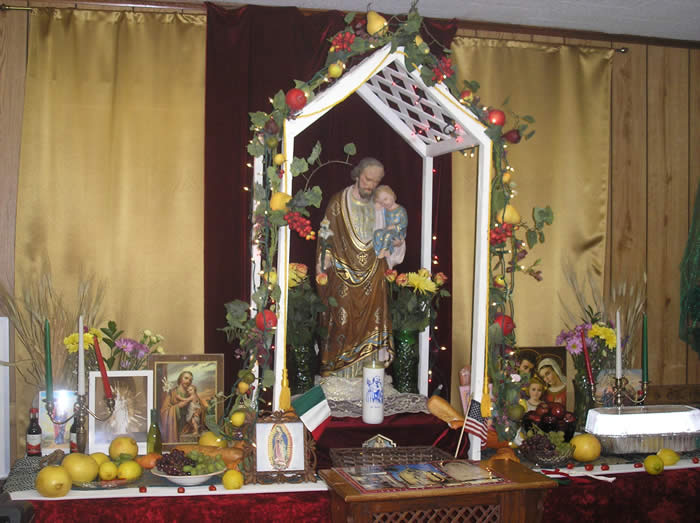
Saint Joseph Altar, Christ the King Church Parish Hall, Lafayette, Lousiana, Laetare Sunday, March 18, 2007
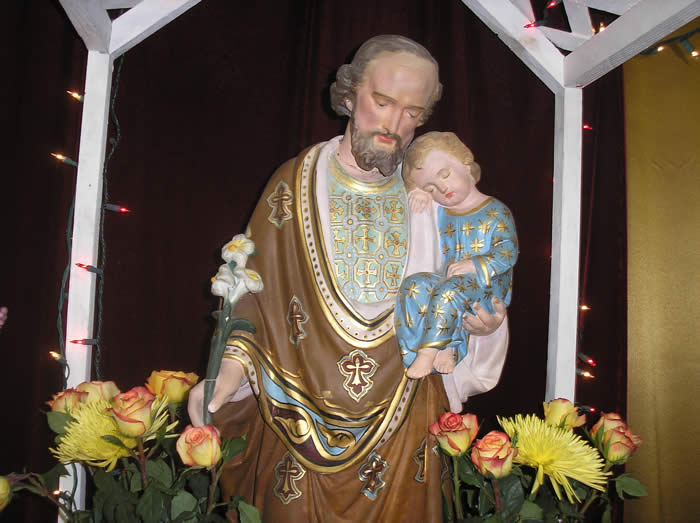
Seven Sorrows and Joys of Saint Joseph
Among the many exercises of piety practiced in honor of St. Joseph, there is one generally known, namely, that of meditating on his Seven Sorrows and Seven Joys. This devotion owes its origin to a celebrated event, never omitted by any historian of the Saint.
It is as follows:
Two Fathers of the Franciscan order were sailing along the coast of Flanders, when a terrible tempest arose, which sank the vessel, with its three hundred passengers. The two Fathers had sufficient presence of mind to seize hold of a plank, upon which they were tossed to and fro upon the waves, for three days and nights. In their danger and affliction, their whole recourse was to St. Joseph, begging his assistance in their sad condition. The Saint, thus invoked, appeared in the habit of a young man of beautiful features, encouraged them to confide in his assistance, and, as their pilot, conducted them into a safe harbor. They, desirous to know who their benefactor was asked his name, that they might gratefully acknowledge so great a blessing and favor. He told them he was St. Joseph, and advised them daily to recite the Our Father and Hail Mary seven times, in memory of his seven dolors or griefs, and of his seven joys, and then disappeared.
(Recite one Our Father, Hail Mary, and Glory Be after each number)
1. St. JOSEPH, Chaste Spouse of the Holy Mother of God, by the SORROW with which thy heart was pierced at the thought of a cruel separation from Mary, and by the deep JOY that thou didst feel when the angel revealed to thee the ineffable mystery of the Incarnation, obtain for us from Jesus and Mary, the grace of surmounting all anxiety. Win for us from the Adorable Heart of Jesus the unspeakable peace of which He is the Eternal Source.
2. St. JOSEPH, Foster-Father of Jesus, by the bitter SORROW which thy heart experienced in seeing the Child Jesus lying in a manger, and by the JOY which thou didst feel in seeing the Wise men recognize and adore Him as their God, obtain by thy prayers that our heart, purified by thy protection, may become a living crib, where the Savior of the world may receive and bless our homage.
3. St. JOSEPH, by the SORROW with which thy heart was pierced at the sight of the Blood which flowed from the Infant Jesus in the Circumcision, and by the JOY that inundated thy soul at thy privilege of imposing the sacred and mysterious Name of Jesus, obtain for us that the merits of this Precious Blood may be applied to our souls, and that the Divine Name of Jesus may be engraved forever in our hearts.
4. St. JOSEPH, by the SORROW when the Lord declared that the soul of Mary would be pierced with a sword of sorrow, and by thy JOY when holy Simeon added that the Divine Infant was to be the resurrection of many, obtain for us the grace to have compassion on the sorrows of Mary, and share in the salvation which Jesus brought to the earth.
5. St. JOSEPH, by thy SORROW when told to fly into Egypt, and by thy JOY in seeing the idols overthrown at the arrival of the living God, grant that no idol of earthly affection may any longer occupy our hearts, but being like thee entirely devoted to the service of Jesus and Mary, we may live and happily die for them alone.
6. St. JOSEPH, by the SORROW of thy heart caused by the fear of the tyrant Archelaus and by the JOY in sharing the company of Jesus and Mary at Nazareth, obtain for us, that disengaged from all fear, we may enjoy the peace of a good conscience and may live in security, in union with Jesus and Mary, experiencing the effect of thy salutary assistance at the hour of our death.
7. St. JOSEPH, by the bitter SORROW with which the loss of the Child Jesus crushed thy heart, and by the holy JOY which inundated thy soul in recovering thy Treasure on entering the Temple, we supplicate thee not to permit us to lose our Saviour Jesus by sin. Yet, should this misfortune befall us, grant that we may share thy eagerness in seeking Him, and obtain for us the grace to find Him again, ready to show us His great mercy, especially at the hour of death; so that we may pass from this life to enjoy His presence in heaven, there to sing with thee His divine mercies forever.
Let Us Pray
O God, Who in Thine ineffable Providence has vouchsafed to choose Blessed Joseph to be the Spouse of Thy most holy Mother; grant, we beseech Thee, that we may deserve to have him for our intercessor in heaven whom on earth we venerate as our holy protector: Who lives and reigns forever and ever. Amen. (Seven Sorrows and Joys of Saint Joseph)
Appendix A
Father Weninger’s Second Sermon on Saint Joseph
"Go to Joseph."--Gen. xli.
When our thoughts dwell upon the saints in heaven, the feeling which predominates in our hearts is admiration of their sanctity and glory. Our first duty, therefore, is to show them the veneration due to them, as the glorified children and servants of God; and among them all, who is so justly entitled to every honor from us as St. Joseph? If every saint has a claim upon our veneration, how much more is this true of him, the holiest of all the saints, whom we have already contemplated, body and soul, by the side of Jesus and Mary on his heavenly throne?
We are, however, accustomed to manifest the sentiments of our veneration toward the saints by offering prayers in their honor, by singing hymns in praise of their virtues, and by saying special litanies to them. But more than all do we show our reverence and esteem by seeking refuge in their intercession in all our needs.
In this regard, each one can follow the impulse of his own devotion, and seek the protection of whatever saint in whose intercession he has the most confidence. But how great soever may be our esteem for the ability of the different saints to aid us, it is, above all, St. Joseph, in whom we may, with the greatest assurance of being heard, confide and hope.
Beloved in Christ, listen to my reasons for saying this, and reflect upon them during the course of your whole lives. O Mary, grant that we may ever confide in the power of the great St. Joseph to hear and help us! I speak in the most holy name of Jesus, for the greater glory of God!
If I wish today to animate your courage and my own so that it may never falter--to fly to St. Joseph in all our needs--nothing can serve so well for this as the declaration of a saint who is held in the highest esteem in the Church of God.
St. Teresa says: "I do not remember to have asked St. Joseph for any thing which he did not grant me." This is a very powerful proof, coming as it does from a saint who certainly never was guilty of exaggeration. What St. Teresa contributed on her part that caused St. Joseph always to grant her petitions, was, no doubt, the unbounded confidence with which she never failed to approach him; and also that her requests were always made in view of her wonderful vow, viz: "Ever to do what was most perfect." Let us imitate her example; and, filled with gratitude, we shall give that honor to St. Joseph which is justly due. As to the confidence which St. Teresa placed in him, I am not astonished at its extent; but rather inclined to wonder that it is not shared to a greater degree by all the faithful. In view of this, I deem it advisable to consider briefly with you the reasons wherefore she entertained it, for her motives for doing so exist for all the children of the Catholic Church.
We employ, with hope and trust, the intercession of the saints, because they are already with Christ, behold God face to face, and are intimately united with Him. Our confidence increases in proportion to the reasons we have for believing that they are exalted above all other saints, and particularly glorified before God according to their calling in His kingdom here on earth.
Secondly, the greater the merit through which they, while on earth, attained greater holiness by God's grace, the more firm will be our confidence in them, especially when they are saints whom our Lord, in different countries and in some special time of need, has appointed intercessors for the children of the Church.
In regard to the degree of glory to which St. Joseph is elevated in heaven, we behold him by the side of Jesus, in company with the Blessed Virgin Mary. This exaltation points, at the same time, to the degree of his union with God the Father, the Son, and the Holy Ghost in the Most Holy Trinity. How indeed could God the Father refuse to hear the prayer of him whom He appointed to be His representative here on earth? In like manner how could God the Son deny him a request, since He was subject to him on earth as his foster-Son? And how could God the Holy Ghost remain deaf to any prayer of his, since He made him protector and spouse of her whom we have the right to designate as spouse of that Divine Spirit? Besides, St. Joseph stands at the side of Jesus, who is at the same time Man, with Mary, His mother. Let him but give the faintest sign, and Mary surely will not refuse to unite her prayer with his that Jesus will grant the petition; for Jesus is almighty, and, through this union with the Saviour and His mother, St. Joseph becomes, so to say, almighty himself.
As I said before, our confidence in the intercession of the saints is increased in proportion to the number of merits they gathered in the service of God, who deigns to glance at them, as we are assured in the Holy Scripture itself by the example of Moses, Job, and Jeremias the prophet.
But, in regard to St. Joseph, the merits of all the other saints are not to be compared to his, for his entire life was spent in the most tender solicitude for Jesus and Mary themselves; and, therefore, each of his works, toils, labors, and affections were of immeasurable value.
Certainly we know of no achievement, individually, which the saints performed, and therefore we are not allowed to exalt one above the other; but, in the case of St. Joseph, he stands pre-eminent above the rest, for the Scripture calls him perfect, just. He was, like Mary, a true mirror of perfection--without a blemish. How great, therefore, must be the pleasure with which the Most Holy Trinity contemplates him and grants all that he asks!
I repeat, that our assurance of being heard by the saints is more certain in regard to those who have performed wonderful things for God, in particular places, and whom He has glorified in times of need as special intercessors.
In regard to the calling of St. Joseph, it was most high and holy, and should be appreciated by all the faithful; for he fostered and protected the Lord and Creator of the world, to whom nothing is impossible.
Very justly, therefore, the holy fathers behold, in the person of the Egyptian Joseph, a figure of St. Joseph. The former was called, by the king, savior, helper. He watched over the granaries and storehouses in which the grain was preserved for the daily bread; but St. Joseph of the New Law cared for the bread which was one day to serve as a nourishment for the nations of the whole universe.
Pharaoh said to the people: "If you want help, go to Joseph;" and our heavenly Father, the King of kings, says: "If you need help, go to Joseph; I will hear his prayers for you." What God once said to the three friends of Job--"Go ye to Job, he will pray for you, and I will hear his prayers"--is most true in regard to St. Joseph,--in all necessities of soul and body there is no exception. Child of the Church, when the dark clouds of grief overshadow your soul, go to Joseph; he is, through Jesus Christ, the consoler of the afflicted. When you are tempted, go to Joseph; call upon him, and the temptations will vanish, or you will victoriously conquer. And if you should yield to the tempter's voice, and fall into sin, still go to Joseph; he will obtain for you the grace of true repentance and conversion.
Are you in good dispositions, but weak and tepid? Look up to Joseph, think of the glorious example of his sanctity, and he will obtain for you the grace of zeal. Are you afflicted with sickness? Go to Joseph, for he, too, is the health of the sick. If a St. Francis Xavier appeared to the suffering Marcellus, during his sickness, and said, "Invoke me, for you must know that I have influence in heaven," still more forcibly can the great saint, whom we devoutly, honor today, declare the same.
Yes, even in your temporal necessities call upon him with confidence, but with the reservation that what you petition for will surely tend to your spiritual benefit; and through his powerful intercession your prayer will not fail to obtain a hearing.
And, more than all, since the Head of the Church Himself has most solemnly dedicated St. Joseph as the patron of the "universal Church," we should, with the utmost faith, seek his gracious assistance. If we have done so during life, then he will surely assist us at the hour of death. Then let us pray daily for this grace, that we, like St. Joseph, may yield up our spirits in the arms of Jesus and Mary; and that, beholding him in heaven, we may eternally thank him for the graces which, through his intercession, we obtained on earth. Amen! (Father Francis Weninger, S.J., Sermon On the Holy Life and Holy Virtues of Saint Joseph.)
Appendix B
Father Wennger’s Third Sermon on Saint Joseph
"Whose name was Joseph, of the house of David."--Luke i, 27.
Who could even think of the glorious St. Joseph, and not feel his heart instantly filled with the deepest veneration and admiration for him, and without being at once impelled to have recourse, with the greatest confidence, to his gracious intercession? Divine Providence has distinguished him in so wonderful a manner above all the other saints, even above the whole celestial choir of angels, by elevating him to the dignity of foster-father of Christ, the Incarnate Son of God, and virginal spouse of the Queen of all saints, that his mediation with the Source of all grace can not fail to be most powerful.
The exceptional graces which have been conferred upon him show us in a moment that the glory and power which surround St. Joseph in heaven, must be, indeed, great beyond conception. But, beloved in Christ, it is not sufficient to admire the heroic lives of the saints, nor even to feel that their intercession is most powerful, for there is one point in the veneration of the saints of much greater importance, and that is, that we are zealous in imitating their virtues. It is this disposition and determination of mind which tend to develop and directly test the greater part of the veneration which we profess to cherish for the saints, and it is particularly in this regard that our confidence will show itself most pleasing to God, as well as to the dear foster-father of the little infant Jesus.
The very name of this great saint contains a lesson in itself as to the manner in which our endeavors to imitate him should proceed, for the signification of Joseph is "The Increasing." And truly, from his wonderful virtue, he is fully entitled to it, for the light of his sanctity grew more and more brilliant, until at last it merged into the glory of the eternal day. This meaning will intimate to us the importance of striving ever to advance in our journey along the way of perfection, that we may resemble the more closely our patron, St. Joseph, who is also the patron of the universal Church.
What our progress in virtue particularly depends upon shall be made plain to you today by a careful consideration of the virtues which distinguished St. Joseph, and which in the course of my sermon I will place before your eyes. O Mary, obtain for us the grace to go on in the way of perfection with a zeal similar to that of him who was appointed by God to assist thee in the guardianship of thy divine Son. I speak in the holy name of Jesus, for the greater honor and glory of God!
"Walk before Me, and be perfect." Thus runs the word of the Lord to Abraham, the father of the faithful. "Be ye perfect as your Father in heaven is perfect," is the injunction of Christ to all the children of men. These words of the Lord indicate at the same time the condition in which we must be to satisfy this command, or, as it may be called, this challenge to the human race. We must strive in every action of our lives to do always the most holy and divine will, even in matters which appear to us of trifling import; and not only must we avoid evil, but practise with continually increasing zeal the duties of our state of life, never for a moment losing sight of the goal we wish to reach--perfection.
It is of his own endeavors that St. Paul speaks when he says: "Brethren, I do not count myself to have apprehended; but one thing I do, forgetting the things that are behind, and stretching forth myself to those that are before, I pursue towards the mark." In a greater or less degree every child of the Church is interested in becoming better and better, after a true Catholic knowledge has so penetrated his heart that he appreciates the duty which rests upon him to advance as far as he can in the path of virtue.
Today I have not in view those every-day Christians who are satisfied with fulfilling the most general obligations which devolve upon them in daily life. I speak to souls who complain that, with all their care to become more pleasing to God, they remain always the same, and, to their utter discouragement, make no progress whatever; who have, indeed, reason to say of themselves: "Instead of advancing, we go back--we know it too well, and, alas! others remark it also, especially those who are constantly with us. How can we help it?" In answer I will call your attention to those virtues which appeared most conspicuously in the life of St. Joseph, which shine forth with the greatest splendor, and are to be called his characteristic virtues.
In the first place, St. Joseph had a most profound esteem for the dignity of his calling. Like St. John the Baptist, he was most deeply impressed with the holiness of the office, which enabled him to walk worthily by the side of Jesus and Mary, and the greatness of the obligation which rested upon him to fulfill its duties in a fitting manner.
The great point wherein so many Christians are deficient, is a want of appreciation of the fact that God has created us for His kingdom; and that where Christ is, there is His kingdom; therefore all upon earth that prevents us from following Him is naught but vanity of vanities, and never sufficient to satisfy our hearts.
The generality of Christians seem to place worldly happiness above all; their principal care is but to possess and to enjoy for as many years as they can. Hence their carelessness in all that relates to their eternal salvation, on the one hand, and, on the other, their excessive care for the things of earth.
Show me a Christian with a will full of sincerity in the service of God, perfectly satisfied to embrace the state of life which God has marked out for him, and he will surely walk before the Lord, and make rapid progress in perfection.
St. Joseph lived in retirement and silence--a hidden life. He lived in the deepest recollection of spirit, keeping God ever in view. And here we perceive one of the principal obstacles which stands in the path of so many who fain would think that they are seeking the most rapid way to perfection.
The constant turmoil in which they live is not conducive to a holy life. They shrink from that solitude wherein the Holy Ghost would speak to their hearts. They are given to much conversing, and that, where neither duty nor Christian charity demands it, is a great source of tepidity and lukewarmness. It sets a most pernicious example, which in many instances destroys whatever efforts are made for the sanctification of souls.
To this is added an excessive fondness for pleasure. What was at once the solace, the joy, and the recreation of St. Joseph, was his intercourse with Jesus and Mary; and this will impart to us a very important lesson. Christ our Lord is the model of all perfection, and after Him ranks Mary as the most faithful imitator of the splendor of those virtues which adorned her Son. For thirty years St. Joseph had this immaculate Mother and her divine Son daily before his eyes. He lived with Jesus and Mary, which circumstance gave him occasion to regulate his life in accordance with their example; and this he did with an assiduity and a fidelity proportionate to his knowledge of and love for them, and the ardor of his desire to resemble them daily more and more.
But, alas! how far removed are men in general from thus knowing and loving Christ and His blessed Mother! Happy the Christian whose heart is inflamed with intense fervor for this dear Mother who was so tenderly cherished by our Saviour; he will continually contemplate the example of her virtues, and fly to her refuge in every spiritual necessity. Such a one leads, indeed, a holy and zealous life; for love for Mary can not exist where there is no love for Christ.
Then, by frequent reception of and intimate union with Him in the Most Holy Sacrament, he will acquire a love of prayer, and a deeper knowledge of Jesus and the life which is hidden with Christ in God. This will open for him an inexhaustible source of grace for the sanctification of his life, and replenish his heart with an ardent love of the cross, and with perfect resignation to the most holy will of God.
In the holy life of the great St. Joseph these dispositions shine most brilliantly forth. God tries His elect by adversity and tribulations, and the dear saint whose festival we celebrate today was no exception to the universal decree. Trials fell to the lot of St. Joseph, and he bowed in submission to the divine will; he remained silent, speaking not even to the angel who spoke to him.
What a heavenly model of silence for all who are really in earnest in their wish to advance in virtue! What resignation, what love of the cross, distinguished this great saint! I declare to you, most beloved in Christ, that the spirit of shrinking from the cross, from self-denial, which we find in so many Christians, is one of the principal causes of the little progress they make in virtue. Oh, what joy it is to meet one who has a tender devotion to the cross through the love of Christ, who finds therein a balm for every ill, and who, when the hand of the Lord is heavy upon him, is willing to give himself to God without reserve!
Therefore, O St. Joseph! we pray thee obtain for us grace and strength to imitate those virtues which shone with such brilliant luster in thy life, and we shall, no doubt, if consistent, reach the height of Christian perfection.--Amen! (Father Francis Weninger, S.J., Third Sermon On the Holy Life and Virtues of Saint Joseph.)
