A Preferential Option for Sin
by
Thomas A. Droleskey
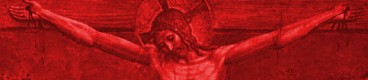
Each of us is a sinner. Each one of our sins transcended time, wounding Our Lord unspeakably in His Sacred Humanity during His fearful Passion and Death. Each one of our sins caused Our Lady's Immaculate Heart to be thrust through and through with swords of sorrow. Each one of our sins wounds our own souls by darkening our intellects and weakening our wills, inclining us all the more to sin and to grow content in a life of spiritual sloth.
Our Lord offered Himself up to the Father in Spirit and in Truth on the wood of the Holy Cross to pay back in His Sacred Humanity the blood debt of our sins that was owed to Him in His Infinity as God. A torrent of overflowing Mercy was opened up when the centurion's lance pierced His side, causing Blood and water, the sacramental elements of the Church, to pour out the fountain of Divine Mercy that is His Most Sacred Heart. That same Sacred Heart, which beats for love for us sinners in every tabernacle in every Catholic church around the world, wants to enfold us in Its ineffable Mercy and love, beckoning us to seek out the life-giving streams of sanctifying grace available to us in the Sacred Tribunal of Penance. Our Lord expects us to hate our sins and to do everything possible, starting with a total consecration to His Most Blessed Mother's Sorrowful and Immaculate Heart, to root out sin from our lives and then to do penance for our sins by offering everything that happens to us, good or bad, to Him through that same Immaculate Heart of Mary.
A Catholic who is struggling to save his immortal soul by cooperating with the graces won for all men by the shedding of every single drop of Our Blessed Lord and Saviour Jesus Christ's Most Precious Blood on the wood of the Holy Cross must be conscious of living penitentially at all times. That is, a Catholic who is truly serious about saving his immortal soul sees every moment of his life as an opportunity to give some offering, whether great or small, to Our Lady's Immaculate to be used for the conversion of sinners, starting with himself. A Catholic who is concerned about pleasing God and dying in a state of sanctifying grace will keep his soul's eternal welfare in mind at every moment of his life, realizing that every word, every thought, every deed has an eternal dimension to it. A Catholic who wants to spend all eternity in Heaven desires to use the will that God gave Him to choose to love Him as He has revealed Himself through His true Church, always seeking to have his will strengthened and his intellect enlightened by sanctifying grace so as to see the world clearly as a Catholic without a moment's concession to the ways of the world, the flesh, and the devil.
How sad it is, therefore, that allegedly "Catholic" institutions of higher education hold annual events to glorify perversion and those who practice it wantonly. My own Master's alma mater, the University of Notre Dame, is holding yet another glorification of perversion in this coming week, which will be the third consecutive year that one of the four sins that cries out to Heaven for vengeance has been celebrated with diabolical delight on the grounds of a university named after the Mother of God. There is not much time that needs to be wasted on how such an event grieves Our Lady's Sorrowful and Immaculate Heart and makes a mockery of all that her Divine Son endured to save us.
Although the word "love" will be bandied about in the next week at the University of Notre Dame, especially as motion pictures extolling perversity are praised in "the name of love," God does not love sin. He hates sin. He despises sin. He wills for us that we root it out of our lives. His Divine Love for us is an act of His Divine Will, that we persist until our dying breaths in states of sanctifying grace as members of the Catholic Church. That is God's love for us, a little matter that is nowhere to be found in the text of Deus Caritas Est, Pope Benedict XVI's first encyclical letter. We do not love God by persisting in sins unrepentantly or by identifying ourselves on the basis of sinful inclinations, whether perverse or natural. We do not love God by reaffirming others in their sins, as Saint Paul reminded us in his Epistle to the Romans:
For the wrath of God is revealed from heaven against all ungodliness and injustice of those men that detain the truth of God in injustice: Because that which is known of God is manifest in them. For God hath manifested it unto them. For the invisible things of him, from the creation of the world, are clearly seen, being understood by the things that are made; his eternal power also, and divinity: so that they are inexcusable.
Because that, when they knew God, they have not glorified him as God, or given thanks; but became vain in their thoughts, and their foolish heart was darkened. For professing themselves to be wise, they became fools. And they changed the glory of the incorruptible God into the likeness of the image of a corruptible man, and of birds, and of fourfooted beasts, and of creeping things. Wherefore God gave them up to the desires of their heart, unto uncleanness, to dishonour their own bodies among themselves. Who changed the truth of God into a lie; and worshipped and served the creature rather than the Creator, who is blessed for ever. Amen.
For this cause God delivered them up to shameful affections. For their women have changed the natural use into that use which is against nature. And, in like manner, the men also, leaving the natural use of the women, have burned in their lusts one towards another, men with men working that which is filthy, and receiving in themselves the recompense which was due to their error. And as they liked not to have God in their knowledge, God delivered them up to a reprobate sense, to do those things which are not convenient; being filled with all iniquity, malice, fornication, avarice, wickedness, full of envy, murder, contention, deceit, malignity, whisperers, detractors, hateful to God, contumelious, proud, haughty, inventors of evil things, disobedient to parents,
foolish, dissolute, without affection, without fidelity, without mercy. Who, having known the justice of God, did not understand that they who do such things, are worthy of death; and not only they that do them, but they also that consent to them that do them. (Romans 1: 18-32)
We love no one authentically if we do anything, either by commission or omission, which interferes in any way in the salvation of another person's immortal soul. There are nine ways by which we can be an accessory to the sins of others:
1) By counsel; 2) By command; 3) By consent; 4) By provocation; 5) By praise or flattery; 6) By concealment; 7) By partaking; 8) By silence; 9) By defense of the ill done.
Any and all events such as the one that will take place at the University of Notre Dame in the coming week are exercises in an institution of "Catholic" education serving as a corporate sponsor of sin, serving as vehicle by which numerous people can reaffirm each other in the very thing that caused Our Lord to suffer in His Sacred Humanity on the wood of the Holy Cross and which wounds His Mystical Body, Holy Mother Church, today: sin. It is one thing to sin and to be sorry, seeking out the Mercy of Our Lord in the Sacrament of Penance. It is quite another to persist in sin unrepentantly, worse yet to promote sinful behavior as the foundation of one's own identity and to thus seek to protect it under cover of law and propagate it in every aspect of popular culture.
Alas, a world that has overthrown the Social Reign of Christ the King as it must be exercised by the Catholic Church loses its mind over the course of time, becoming incapable of stopping a downward spiral in the abyss of a hedonism that would have shamed the barbarians of yore. Pope Leo XIII noted the fact that a society that is not founded on a frank and confessional recognition of the Catholic Church as the state religion descends into complete and total moral anarchy. Writing in Immortale Dei in 1885, Pope Leo XIII stated clearly where the "civil liberty" of the modern state takes men and their nations:
So, too, the liberty of thinking, and of publishing, whatsoever each one likes, without any hindrance, is not in itself an advantage over which society can wisely rejoice. On the contrary, it is the fountain-head and origin of many evils. Liberty is a power perfecting man, and hence should have truth and goodness for its object. But the character of goodness and truth cannot be changed at option. These remain ever one and the same, and are no less unchangeable than nature itself. If the mind assents to false opinions, and the will chooses and follows after what is wrong, neither can attain its native fullness, but both must fall from their native dignity into an abyss of corruption. Whatever, therefore, is opposed to virtue and truth may not rightly be brought temptingly before the eye of man, much less sanctioned by the favor and protection of the law. A well-spent life is the only way to heaven, whither all are bound, and on this account the State is acting against the laws and dictates of nature whenever it permits the license of opinion and of action to lead minds astray from truth and souls away from the practice of virtue. To exclude the Church, founded by God Himself, from life, from laws, from the education of youth, from domestic society is a grave and fatal error. A State from which religion is banished can never be well regulated; and already perhaps more than is desirable is known of the nature and tendency of the so-called civil philosophy of life and morals. The Church of Christ is the true and sole teacher of virtue and guardian of morals. She it is who preserves in their purity the principles from which duties flow, and, by setting forth most urgent reasons for virtuous life, bids us not only to turn away from wicked deeds, but even to curb all movements of the mind that are opposed to reason, even though they be not carried out in action.
It is bad enough that the course of a country founded in an specific and categorical rejection of the necessity of belief in the Incarnation and the Deposit of Faith as necessary for personal sanctity and all social order will degenerate logically and inexorably to the point where we now find ourselves. What is even more tragic, however, is that ecclesiastical officials, including Pope Benedict XVI, believe that the American model of separation of Church and State must be embraced as a virtue rather than as the abject evil and abomination in the sight of God that it is, denying Him His rights to be recognized as the King of all men and of all nations. The Diabolical Disorientation produced by the embrace of the false spirit of a demonic age is what makes it impossible for the Church in her human elements to rein in such dens of iniquity as the University of Notre Dame (and other allegedly "Catholic" institutions). Such institutions are merely the result of the very spirit that has been praised since Gaudium et Spes was adopted by the Second Vatican Council on December 7, 1965. Nothing short of a return to Tradition, which itself will be the fruit of the Triumph of Our Lady's Sorrowful and Immaculate Heart, can re-Catholicize institutions gone mad in a world of madness, a world shaped by the spirit of Modernity's warfare against the Church and Modernism's warfare against Catholic Tradition.
Our Lady appeared on this very day, February 11, 1858, to Saint Bernadette Soubirous in the grotto of Massabielle. She proclaimed herself on March 25, 1858, to be the Immaculate Conception. As we approach Septuagesima Sunday tomorrow, February 12, 2006, perhaps it would be an effective antidote to the smut and muck that will be propagated at the University of Notre Dame this coming week to reflect on the messages of Our Lady to Saint Bernadette at Lourdes, reminding us to root out sin in our own lives and to do penance for our sins and those of the whole world.
Saint Bernadette's own words tell us the amazing events that took place in the south of France starting 148 weeks ago this very day:
"The first time I went to the Grotto, was Thursday, 11th February, 1858. I went to gather firewood with two other little girls (Toinette, her sister, and Jeanne Abadie, nicknamed Balourn). When we got to the mill (of Savy), I asked the other two if they would like to see where the water of the mill joins the Gave. They said 'Yes.' From there we followed the canal. When we arrived there (at the foot of the rock of Massabielle) we found ourselves before a grotto. As they could go no further, my two companions prepared to cross the water lying before their path; so I found myself alone on the other side. They crossed the water; they started to cry. I asked them why and they told me that the water was cold. I begged them to help me throw a few rocks into the water so that I could cross without taking my stockings off. They replied that I could do as they had done. Then I went a bit further to see if I could cross without taking my stockings off, but without success." "I came back towards the grotto and started taking off my stockings. I had hardly taken off the first stocking when I heard a sound like a gust of wind. Then I turned my head towards the meadow. I saw the trees quite still: I went on taking off my stockings. I heard the same sound again. As I raised my head to look at the grotto, I saw a Lady dressed in white, wearing a white dress, a blue girdle and a yellow rose on each foot, the same color as the chain of her rosary; the beads of the rosary were white." "The Lady made a sign for me to approach; but I was seized with fear, and I did not dare, thinking that I was faced with an illusion. I rubbed my eyes, but in vain. I looked again, and I could still see the same Lady. Then I put my hand into my pocket, and took my rosary. I wanted to make the sign of the cross, but in vain; I could not raise my hand to my forehead, it kept on dropping. Then a violent impression took hold of me more strongly, but I did not go." "The Lady took the rosary that she held in her hands and she made the sign of the cross. Then I commenced not to be afraid. I took my rosary again; I was able to make the sign of the cross; from that moment I felt perfectly undisturbed in mind. I knelt down and said my rosary, seeing this Lady always before my eyes. The Vision slipped the beads of her rosary between her fingers, but she did not move her lips. When I had said my rosary the Lady made a sign for me to approach, but I did not dare. I stayed in the same place. Then, all of a sudden, she disappeared. I started to remove the other stocking to cross the shallow water near the grotto so as to join my companions. And we went away. As we returned, I asked my companions if they had seen anything. 'No,'; they replied. 'And what about you? Did you see anything?' 'Oh, no, if you have seen nothing, neither have I.' " "I thought I had been mistaken. But as we went, all the way, they kept asking me what I had seen. I did not want to tell them. Seeing that they kept on asking I decided to tell them, on condition that they would tell nobody. They promised not to tell. They said that I must never go there again, nor would they, thinking that it was someone who would harm us. I said no. As soon as they arrived home they hastened to say that I had seen a Lady dressed in white. That was the first time."
"The second time was the following Sunday [February 14, 1858]. I went back because I felt myself interiorly impelled. My mother had forbidden me to go. After High Mass, the two other girls and myself went to ask my mother again. She did not want to let us go, she said that she was afraid that I should fall in the water; she was afraid that I would not be back for Vespers. I promised that I would. Then she gave me permission to go."
"I went to the Parish Church to get a little bottle of holy water, to throw over the Vision, if I were to see her at the grotto. When we arrived, we all took our rosaries and we knelt down to say them. I had hardly finished the first decade when I saw the same Lady. Then I started to throw holy water in her direction, and at the same time I said that if she came from God she was to stay, but if not, she must go. She started to smile, and bowed; and the more I sprinkled her with holy water, the more she smiled and bowed her head and the more I saw her make signs. Then I was seized with fright and I hurried to sprinkle her with holy water until the bottle was empty. Then I went on saying my rosary. When I had finished it she disappeared and we came back to Vespers. This was the second time."
The third time was the following Thursday [February 18, 1858]. The Lady only spoke to me the third time. I went to the grotto with a few grown–ups, who advised me to take paper and ink, and to ask her, if she had anything to say to me, to have the goodness to put it on paper. I said these words to the Lady. She smiled and said that it was not necessary for her to write what she had to say to me, but asked if I would do her the favour of coming for a fortnight. I told her that I would. She told me also that she did not promise to make me happy in this world, but in the next."
Our Lady gave Saint Bernadette a message on February 24, 1858, a message that she has given on numerous occasions since that time, especially at Fatima fifty-nine years later: that we must do penance for our sins an those of the whole world. Our Lady spoke the following words:
"Penance!"
"Pray for the conversion of sinners."
Do you think that such penance will be practice or that such prayers will be offered by the Holy Cross Fathers at the University of Notre Dame next week? Do you think that our pervert-friendly bishops, many of whom are so eager to demonstrate their false "compassion" for people steeped in perverse inclinations and/or perverse actions, take to their own hearts the words of Our Lady spoken at Lourdes or the words she spoke at Fatima?
As one website devoted to Saint Bernadette and Our Lady's apparitions at Lourdes notes, everything that happened during Our Lady's visits had a profound spiritual meaning
The disgusting mud of the pig–sty symbolizes penance. Bernadette, with her face smeared by the mud, becomes a symbol of the deep love that led Jesus to His Passion. She invites us to see the true nature of sin and observe the ugliness of evil. Tasting the bitterness of the grass in the Grotto, she courageously sought penance and the conversion of sinners. This was no simple act of symbolism. Bernadette suffered the disdain of the crowds, as they misunderstood her actions and lost faith in her. Jesus also was disfigured as he carried the cross. The mob mocked and spat at Him. He carried the weight and sins of the entire world on his battered shoulders. True penance enables us to see ourselves as the sinners that we are, and helps us as we recognize our mutual misery and be more compassionate towards each other.
At the ninth apparition, Mary asked Bernadette to scrape the ground, saying to her "Go to the spring, drink of it and wash yourself there." There is only a little muddy water to begin with, enough for Bernadette to drink. At first this water is muddy and dirty then, little by little, it becomes clear. The spring signifies the cleansing of the human heart, wounded by sin yet healed through prayer and penance. Bernadette was asked what the lady said to her. She replied, "Now and again she would say, 'penance, penance, penance, pray for sinners.' " Praying leads us to the Spirit of God. We understand that sin is contrary to the love of God and revealed to us through the Gospel.
Imagine if the story of Lourdes was taught at "Catholic" institutions of higher [mis-] education as opposed to the glorification of the very thing that caused Our Lord to suffer during His Passion and Death and still grieves His Blessed Mother's Immaculate Heart to this very day, the muck of unrepenant sin, of the mud that is placed on souls voluntarily and left there as a badge of honor by men who want to realize perverse pleasures in this life rather than seek to please God here on earth so as to be happy with Him for all eternity in Heaven. Saint Dominic Savio had a motto, "Death rather than sin," that ought to be the motto of each Catholic. Woe to those who have a preferential option for sin, eschewing these great words of Saint Dominic Savio, uttered to another boy at Saint John Bosco's Oratory:
“You ought to know that here we find holiness through being very happy! We try to avoid sin, which robs us of God’s grace and our peace of mind, and we carry out our duties as well as we can.”
Saint Louis IX, King of France, wrote the following to his son, Philip, by way of explaining that holiness of life was the only foundation of serving as a just ruler over his fellow Catholics:
You should, with all your strength, shun everything which you believe to be displeasing to Him. And you ought especially to be resolved not to commit mortal sin, no matter what may happen and should permit all your limbs to be hewn off, and suffer every manner of torment, rather than fall knowingly into mortal sin.
This is the spirit that should guide every Catholic at all times, not the perverse spirit being celebrated at Our Lady's university in northern Indiana this coming week. This is the spirit that should prompt us with the arrival of Septuagesima Sunday to increase our practices of penance (prayer, fasting, mortification, almsgiving) in preparation for a holy, well-lived season of Lent, which begins on Ash Wednesday, March 1, 2006. We are called withdraw more and more from the things of this passing world in order to unite ourselves with the forty days of Our Lord's own fasting and self-denial in the desert before He assumed His Public Ministry. We are called to deny ourselves in special ways for the next nine weeks so as to participate joyfully in a glorious celebrate of Our Lord's Easter victory over sin and eternal death. We are called to give ourselves totally to Our Lady's Sorrowful and Immaculate Heart, seeing it as a singular privilege to offer her our prayers and sufferings and humiliations for the conversion of all sinners, including ourselves.
May the coming season of Septuagesima and the one that follows it, Lent, help us to hate sin more and more and to love God so much that we pray for crosses and sufferings so as to give Him more and more offerings for the conversion of sinners through His Most Blessed Mother's Immaculate Heart.
Our Lady of Lourdes, pray for us.
Saint Joseph, pray for us.
Saints Peter and Paul, pray for us.
Saint Peter Damian, pray for us.
Saint Bernadette Soubirous, pray for us.
Saint Dominic Savio, pray for us.
Saint John Bosco, pray for us.
Saint Agatha, pray for us.
Saint Lucy, pray for us.
Saint Agnes, pray for us.
Saint Aloysius Gonzaga, pray for us.
Saint Francis of Assisi, pray for us.
Saint John Berchmans, pray for us.
Saint Maria Goretti, pray for us.
Saint Rose of Lima, pray for us.
Saint Rita, pray for us.
Saint Therese Lisieux, pray for us.
Saint Philomena, pray for us.
Blessed Jacinta, pray for us.
Blessed Francisco, pray for us.
Sister Lucia, pray for us.